Learning about mapping data was a most enlightening experience, and one I was looking forward to the most. I do love a good map. I was therefore surprised by the fact that my initial conclusions, based solely on a point map were, well, wrong, as was soon revealed by other maps. The original point map showing the locations and basic data regarding the New Deal era slave narratives from Alabama led me to conclusions that the major metropolitan areas of Alabama (Montgomery, Birmingham, and Mobile) were where the most interviews took place.
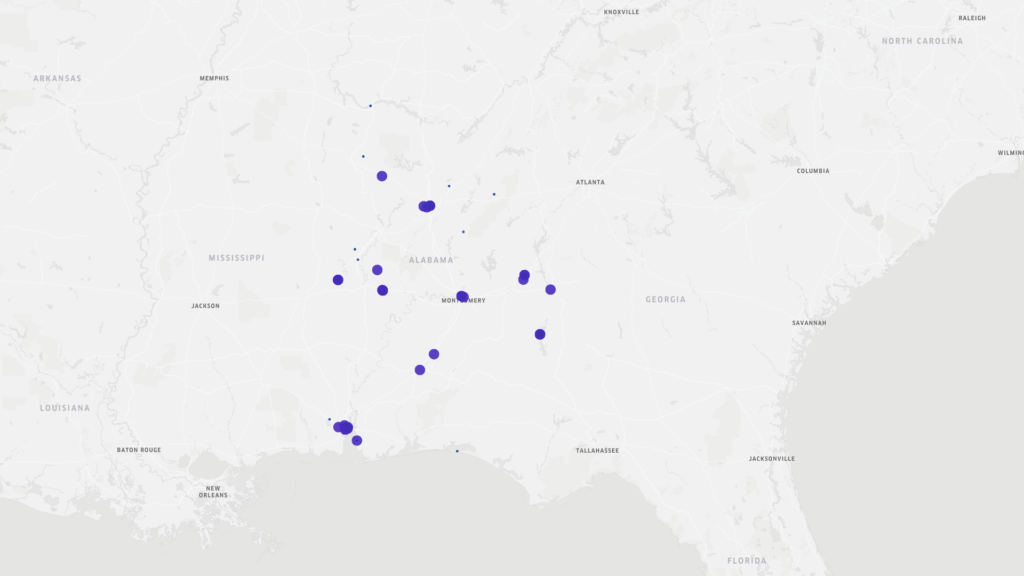
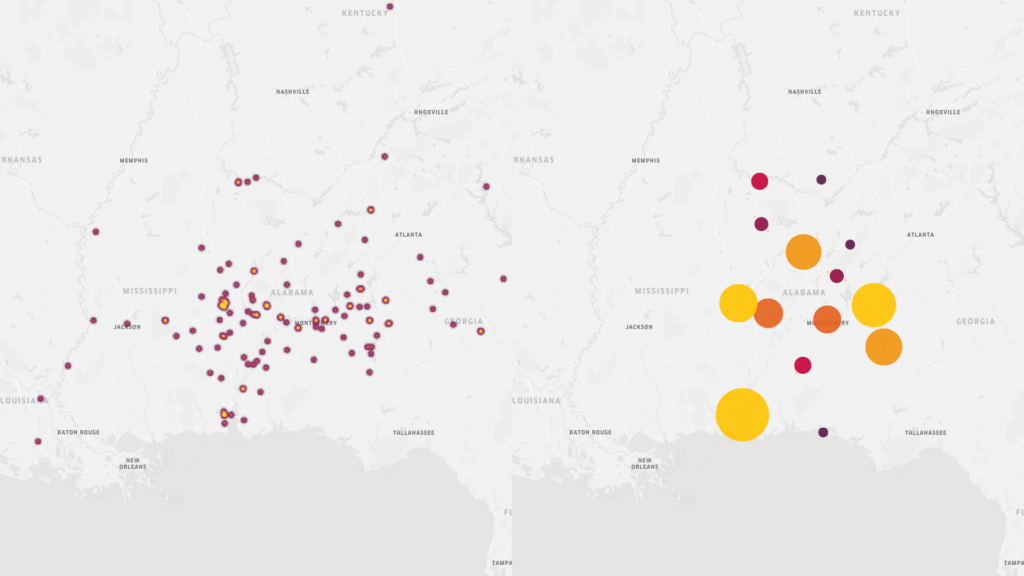
This was true to an extent. However, when moving to maps that show concentrations of interviews in other manners (heat and cluster maps) Mobile still stands out as a key area of concentration, however, we also see other areas outside of Birmingham and especially Montgomery that show greater interview activity.
The original map above also provided information regarding the place of birth of the interviewees. Just a brief visual scan of this information led me to believe that most of the interviewees were born near where they were interviewed. However, an arc map that showed the place of birth v. the place of interview gave a different picture. There was much greater mobility of formerly enslaved people than first believed. Trying to read the information on the original map was difficult as the points overlapped. Furthermore, reading the information still wouldn’t give as clear of a story as the map does.
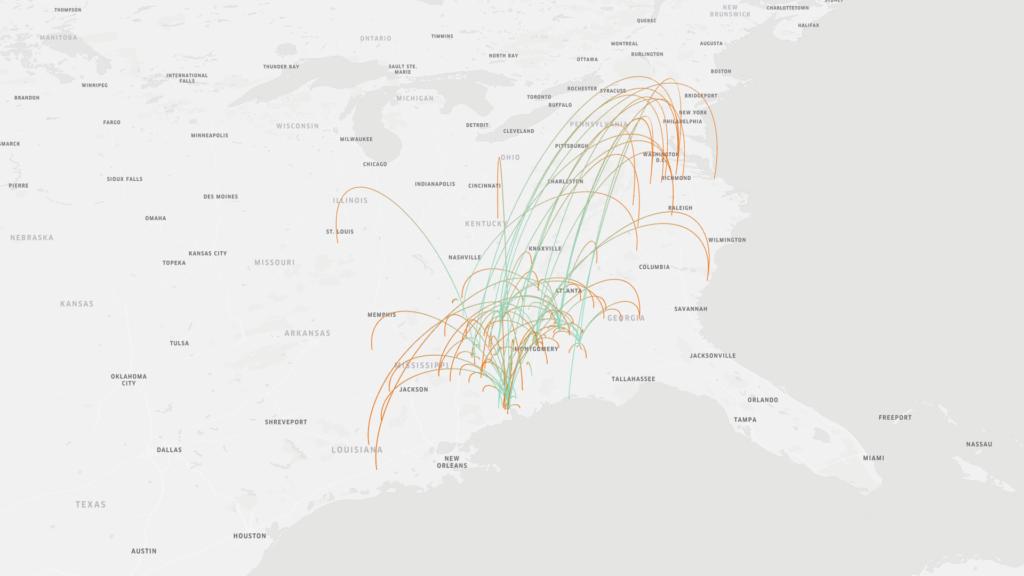
The Kepler mapping tool is helpful in making sense of spatial data in a “big data” collection such as the New Deal slave narratives. However, it is a learning curve. Understanding how to input parameters was relatively easy when given explicit instructions (thank you), but when I went back and tried to recreate the maps and create new ones, I was a bit confused. Like with so much it will take time. However, reading these various maps brought up questions that I would not have considered if I was just reading the text of the interviews, particularly about movements of people after emancipation.
Biggest lesson learned: never finish with first readings. Rearrange the material. Ask other questions, See how the results differ.
