Teaching in the digital world

While the struggles to make sure students use appropriate online sources, the benefits of online resources available the internet greater than the negatives. For one, as an educator, there are so many wonderful resources available and ready to go, which is such a time saver. I don’t like to use traditional text books in my class because students don’t really engage with them and they’re horribly expensive. However, there are great online resources such as the teachinghistory.org website. On this site I started with the “Causes of the American Revolution” module. The module was authored by a highly respected scholar in the field and provided both an interpretive essay and primary sources that help to illustrate this point. This module helps us move beyond the “no taxation without representation” cry that is just a single part of these complicated causes. I could have scoured the internet for these sources and explained them in class, but, hey, Rosemarie Zagarri already did. It allows me the time to focus on how to discuss the sources in class and create activities for the students to engage with the sources. It allows me to find content I believe is helpful in getting the students to think historically, and not just memorize facts and dates. In many ways, the content is secondary to the process of getting students to read sources, ask questions, and formulate interpretations.

Students like to read primary sources; they really do. This past spring I watched a group of 13 history majors get super into census data from one county in NH in 1850 and the same county in 1870. They made great observations and asked good questions. These were photocopies of the originals. Then they got the opportunity to search for an online archive that had information on a topic of interest. They had a really good time searching for and reading these sources. Some learned the lesson of why we study foreign languages as what they were interested in was written in Spanish or German. But they all got the experience of looking at primary sources that would not be available to them without the internet or a research budget. They really do enjoy getting to “do” history, and the internet allows students at a small, liberal arts school in upstate NY to do that. Even with the challenges, online resources open a whole new world to students, and to the professors too.

Fifth Piece of the Puzzle or maybe 4th 2.0

My project is titled “Contested History: 17th Century Encounters of the French Jesuits and the Onondaga Nation.” My audience are undergraduate students, primarily history majors, at Le Moyne College, which just so happens to be named after one of those French Jesuits and stands on Onondaga ground. I am designing the project for students to be able to do a few things. First, I want them to understand that interpreting the past can come up with different, and sometimes conflicting, results. Second, I want them to think about why, as students at Le Moyne college, this matters and why the story is still relevant today. Third, I want them to understand how and why the primary sources that we use to interpret this encounter were created and how that affects the way we read them as evidence. Fourth, I want them to create their own digital project that tells the story of the encounter and its significance for other Le Moyne students, the vast majority of whom know nothing about the topic. Although this assignment probably won’t be part of this project.

Now it’s time for a bit of confession–Le Moyne is a Catholic college after all. My biggest obstacle was my lack of planning on other projects. Last week I did not get much done on this project as I spent most of my time working against an article deadline I let sneak up on me, although when you are watching it coming, I guess “sneak” isn’t the right word. I also had several big meetings. Now I feel like one of my own students, hat in hand, giving my excuses. Alas, as they would say “It’s not an excuse, just an explanation.” The one good part is that the article dealt in part with the Jesuits and Onondagas so I found some additional information online that could help the project.

I have the Google site organized and the “background” done. I hit “submit” on the article (fingers crossed) and now it’s time to get down to creating the content and assignments for the source reading segments.

Final Project Update

I feel like I am on a path with this project, which is titled “Contested History: 17th Century Encounters of French Jesuits and the Onondaga Nation.” I am created a Google site with, right now, 5 parts: “introduction,” “why it matters,” “past and current interpretations,” “reading the sources: Jesuit Relations,” and “reading the sources: Wampum Belts and Oral Traditions.” I am trying to keep the first three sections as simple and straightforward as possible with just enough information to get to the main goal of this project, which is learning how historians read, question, analyze various historical sources. For right now I am planning on having the students read, question, and analyze two excerpts from the Jesuit Relations. I’d like to do more, but I am trying not to overwhelm students with what are fairly difficult readings. I will also introduce students to reading wampum belts, which goes hand in hand with oral tradition. I feel a bit more comfortable with the process of working with the Jesuit Relations. I will really have to focus on the process of reading Native sources. A challenge here is to get students to understand the difference in methodology while also seeing the similarity in value of Native sources as historical evidence, and to do so in a way that is not overwhelming.

In addition to a slow paced, step by step approach to reading the various sources I am planning on having students create their own primary sources depicting one event of historical importance. Right now I am thinking of having them write two sources each to a different audience. I am hoping this will help them understand how important it is to think of any source’s audience and purpose. The Jesuit Relations were written for a very specific purpose and to a particular audience. This affects, or it should affect, the way we read, question, and analyze them. However, I have discovered this is a difficult concept for students to grasp. They often take the information in the source at face value. Historians and history enthusiasts have done this with the Jesuit Relations and have created some questionable interpretations. Students will take that same event and create a visual record of it to get a better grasp on how oral and visual cultures created their own historical record. This will also require a bit more thought on exactly how I want them to approach this, as I also want an oral element to go with it.

The final objective of the entire project will be for students to create a digital project telling the story of this history to fellow Le Moyne students. But before we can do that, the tough work of reading, questioning, and analyzing the sources must be done, and too often, faculty, myself included, assume that students can do this with a bare minimum of preparation.

That final objective will have to wait until after this piece of the project is complete. One of the biggest take away points from this week’s readings, viewings, and discussions has been to keep things focused for this project. So while I have a bigger puzzle in mind, I need to focus on this particular element that involves the steps of reading primary sources. As stated above, I want to keep the first three elements of the site as streamlined as possible to focus on the final two which are all about reading, questioning, and analyzing the sources. This will provide enough discomfort without being paralyzed by trying to do too much too soon.

Fourth Piece of the Puzzle

So poster making is not my strong suit, but we all must start somewhere. The audience here is my undergraduate Introduction to Public History class. The goal is to pique curiosity in methods and narrative of the history of Le Moyne College.

Film, digital story telling, and teaching history

I will admit, I am not a big movie-watching person. Typically, when someone starts the question “have you seen______?” I can answer no before he or she actually names the movie. That being said, I have tried to use some film in classes, mostly because it appeals to students. I have used Glory and Tora! Tora! Tora! in my early US survey and historical methods classes respectively; I am not a specialist in either time period.

In using Glory, which is the story of the Massachusetts 54th Black regiment in the Civil War and stars such big names as Denzel Washington, Morgan Freeman, and Matthew Broderick, I focus the students on the question of why individuals chose to fight the war. Broderick’s character, Colonel Robert Shaw, is based on a real individual and the creators of the film used Shaw’s writings as a source for the film and as actual dialog. For the Black soldiers of the 54th, although we know there were individuals such as Frederick Douglass’s son Lewis was in the regiment, the creators decided not to actually portray him. Instead there are composite characters that depict the various backgrounds of the members of the 54th, from highly educated northern free-born Black men to those who escaped slavery. This would be a main point of discussion and could highlight the diversity of people and motives at the time. Yes, there are factual errors in the film, for example, the timing of the pay uprising was wrong. But we could talk about the choices the creators made and how important those errors are to the main purpose of the film.

Tora! Tora! Tora! I used in my historical methods class, and we focused on it as a primary source, so not so much the story it told, but the context around its creation. It was released in 1970 in the midst of protests over the Vietnam War. This film is a big departure of the WWII films staring John Wayne. The focus on the film is really about the blunders of American military decision making that allow for the successful surprise attack of the Japanese on Pearl Harbor. This context is crucial in understanding many films, including Gone With the Wind, which, I will admit, I have not been able to stay awake through or the various versions of Last of the Mohicans, which I have taught along with the book; I did get through reading Gone with the Wind, but I really cannot put myself through using it in class. Such films, and novels, tell us much more about the times in which they were created than the history they depict.

While full length films are not really my cup of tea (how can people sit still that long without falling asleep?), I do like the idea of having students “do history” by creating scholarly digital storytelling. The examples that I saw, particularly the pieces on the displaced peoples of Shenandoah National Park and the “Finding Kate”, were wonderful pieces of historical story telling. The Shenandoah piece has that focus on an individual to tell the story of the region, while “Finding Kate” was an effective story on how historians do their work as the author tried to uncover the history of one of George Washington’s enslaved women. Both illustrate the skills of the historian: research, interpretation, narration, but with the use of films, I could see the former piece being the result of work in a class built more around content, while the latter serves as a great example of a piece from a course built more around method. So while the students showed the same research and writing skills of a historian, their use of visual materials made the stories much more memorable. I would LOVE to be able to do this for my own work as well as teach my students. The technical skills are the missing link. I do not know how to create the digital pieces, let alone teach others. I believe students would also be more receptive to telling their stories this way as opposed to writing yet another long essay.

Black Robe film review

1991, Directed by Bruce Beresford and adapted by Brian Moore from his 1985 novel Black Robe. 101 minutes. Can be found on YouTube at https://www.youtube.com/watch?v=QMcUG2YDeu8.

Black Robe focuses on the trials and travels of a 17th century French Jesuit and his young companion as they travel 1500 miles from Quebec City to a Huron mission by canoe. The film, adapted from a 1985 novel of the same name, is a fictional account, but does utilize the Jesuit Relations, which are the collected writings of Jesuit missionaries in North America from the 17th century through the 19th century. While using primary sources, the Jesuit Relations are notoriously difficult to use as they were primarily accounts highlighting the trials and tribulations and successes and sacrifices of the Jesuits as they worked among the sauvages for the “greater glory of God.”

When looking at Black Robe through the lens of historical thinking, we can see a couple major themes that are useful to consider, which are the way the creators depict both the similarities and differences between the cultures. This can be seen in two key scenes in the movie. Early on in the film, as the Jesuits and their First Nations guides are preparing to leave Quebec City for their journey to Huronia, we see celebrations and ceremonies of both the French colonists and Indigenous peoples. Both groups are shown alternatingly dancing to their own music. Furthermore, we see their leaders, Champlain for the French and Chomina for the Algonquians, putting on their own ceremonial garb. So the actions are the same, but the details of culture, clothes, music, dancing, etc, are different. The two groups and their leaders meet so the French can give the Algonquians goods–axes, knives, tobacco, cloth–in exchange for escorting the Jesuit and his young companion to the Huron mission 1500 miles inland. There is a line from what appears to be a French nobleman who witnesses the dancing and the ceremony. He says “We’re not colonizing the Indians, they’re colonizing us (12:19).” This sums up a key argument that historian James Axtell made in his 1985 monograph The Invasion Within: The Contest for Culture in Colonial North America and further explored in Colin Calloway’s 1998 monograph New Worlds for All: Indians, Europeans the Remaking of Early America, which is how the various forms of exchange in colonial North America–economic, cultural, biological–was a two way street between Europeans and Indigenous peoples.

This theme of the back and forth of cultural exchange as well as the tensions between the two groups can further be seen in the person of Daniel Davost who serves as Fr. LaForgue’s companion. Daniel speaks Algonquian and while he says he is interested in becoming a Jesuit, he soon finds himself drawn to the young Algonquian woman Annuka, the daughter of Chomina and part of the obligatory love interest of the film. He learns of Algonquian religious beliefs and explains their ideas of an after life to Fr. LaForgue who calls them childish. Daniel’s response is “Is it harder to believe than a paradise where we all sit on clouds and look at God (44:10).” Again we see the sameness in having understandings of an afterlife and creator but the differences in those beliefs create the tensions between the two.

Visually I enjoy how the director juxtaposes the religious environments of the two groups. Fr. LaForgue is lost in the woods and the director shoots from a low perspective looking up and alternating between panning through the trees of the North American forest and then the high arches of European cathedrals. Both sacred spaces that take the eyes of the viewer to the skies but where LaForgue, who is home in a cathedral, is lost and afraid in the forest (39:30).

Black Robe was hailed by many as a film from an Indigenous perspective, but there are several issues with the veracity of this, and this is probably where many of the historical inaccuracies are. One of the biggest issues is the depiction of the Mohawks as bloodthirsty savages. Of course, this is how they are portrayed in the Jesuit Relations. The director tries to mitigate this with Chomina saying that the Mohawks are no different than the Algonquians, but the actions of the Mohawks speak louder. Chomina’s son is killed in front of him by the Mohawks and his daughter, Annuka, gives herself sexually to their Mohawk guard in order for Chomina, Annuka, Daniel, and LaForgue to escape. Neither of these events are likely to have happened, but they make for good cinema. You need a bad guy, and, unfortunately, the Mohawks continue to serve that stereotyped purpose well into the 20th century.

Black Robe allows for several different questions regarding historical thinking. I would ask students to look for those moments where not only the past was a foreign country to us, and their are many, but how the film depicts the sameness and differences among the First Nations and the French. The two groups had to negotiate the same tensions of foreignness that we do today when looking back historically. I would also like for the students to look at the Jesuit Relations and see how they were used in the film. Here we get into all sorts of issues of using primary sources. As stated above, the Relations are notoriously problematic. How does the director deal with those issues? To answer that, first students would have to look into the Jesuit Relations themselves and understand those texts as historical evidence and not just information. I also would want students to ask questions regarding the depiction of Algonquian thoughts and Mohawk practice, as well as the character of Mestigoit, a Montagnais shaman who was cast as a spiritual counter to LaForgue. If some of the depictions are not accurate, I want students to research what is accurate? Do the inaccuracies take away from the historical value? Lastly, I would want students to view the film as a primary document itself. It was filmed in 1991, a year before the 500th anniversary of Columbus’s arrival in the “New World.” How does that fact affect our understanding of the film’s message?
Third Piece of the Puzzle

The biggest challenge in regards to sources will be in collecting and framing the discussions and assignments of Onondaga oral traditions and material culture in the form of wampum belts. Historical methods and thinking in an Indigenous American context are different from what students already struggle with. I am already familiar with some good video sources online, and we also have a nearby Onondaga Heritage Center that will be useful for students, but how this will look in the final puzzle is still TBD.

Of course, the Jesuit Relations are no easy source for students to grasp either. They LOVE 17th century writing, she types with an eyeroll. So do I pick the excerpts I want them to focus on or do I have them search? Maybe a little of both? More TBD.

I am wondering about activities for students. I am considering the idea of a “scavenger hunt” of sorts early on where they would find and identify references to the Onondaga/Jesuit encounter on campus. That would include names on dorms, statues, a tree of peace, the college seal, the land recognition statement, etc. I am thinking of ways to for students to report on their findings which would not be reports. Maybe I’d have them do short films for social media.

Next I also need to think of the platform. I will be experimenting with Google sites as a possibility as well as WordPress. I also need to really focus on my goals for the students. What are the real skills and knowledge I want them to take away? This puzzle seems to be acquiring more pieces as I continue!

Second piece of the puzzle

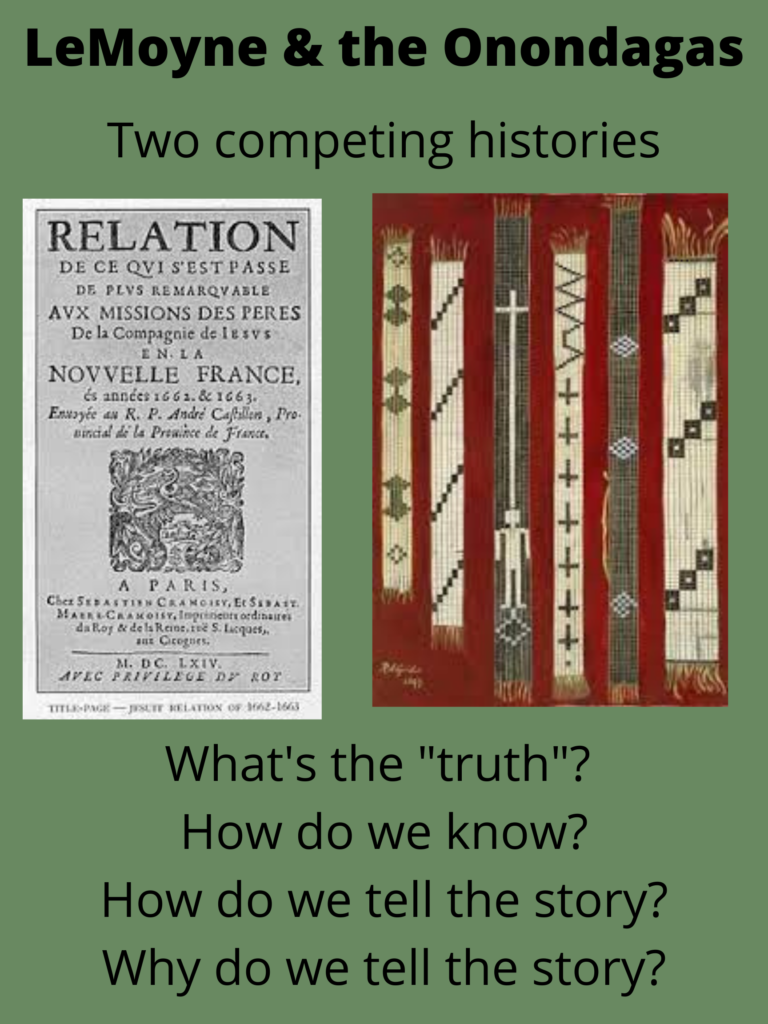
Well, actually, I am changing puzzles. While I will still be thinking of ways to focus and design my monument assignment, our class meeting on Tuesday sparked some ideas, and, I think, a more interesting puzzle. I work at Le Moyne College, named after Simon Le Moyne a seventeenth-French Jesuit and one of the first Europeans to enter what is now Central New York. We sit on Onondaga land. The Onondagas are one of the original five members of the Haudenosaunee (Iroquois) and, as the centrally located nation in the metaphorical Haudenosaunee longhouse, they are also known as the Keepers of the Fire, which is the symbolic fire of the Haudenosaunee Confederacy. When Simon Le Moyne and his Jesuit and French compatriots arrived, well, that’s where the story gets interesting, and quite complicated and the source of tensions between the Jesuits and Onondagas to this day. Talk about your narrative and counter-narrative! The sad thing is that most of our students, even history majors, have no idea about this history.

For students to create a narrative and/or counter narrative with this story, use of digital media will make it much easier. The primary sources for the Jesuits version of events is the Jesuit Relations. Man those Jesuits wrote a lot. Creighton University has all of the volumes of the JR digitized, and they are easy to search, at least for European names. We will have to discuss the use of Iroquioan language in the JR. These sources are quite problematic and will serve as a good lesson on reading primary sources for evidence as opposed to information. Primary sources for the Onondagas are a bit trickier, but, again, digital media will help. These sources will come in the form of oral tradition and the use of wampum belts. There are videos of Onondaga people discussing these belts and traditions. These sources are also problematic and will offer another challenge for students in evaluating them as evidence. FUN!

There is also a local museum that we will be visiting as a class. It used to be known as Ste. Marie Among the Iroquois, and locals referred to it as the French fort. It was interpreted according to the story found in the JR. it is now known as Ska-nonh: Great Law of Peace Center and tells the story of the Onondaga. At the center, there are videos of Onondaga peoples telling their stories. This will also help the students understand that narrative.

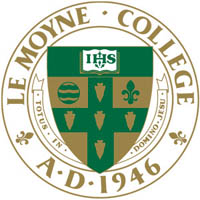
I would like to have students create a digital project from this work. The story will also cover issues of land dispossession, the rise of the salt industry in Syracuse (our nickname is the Salt City and not because our roads are covered in it come winter.) It involves the history of the Catholic church as the Jesuits worked and failed to convert the Onondagas, and of the Jesuit institution where they spend four years of their lives. The names of the French Jesuits are everywhere on campus: Dablon, Brebeuf, Daniel, and, of course, Le Moyne. The history of the Onondaga is no where to be seen, although the college seal includes five arrowheads; they are pointing down, indicating the Jesuits supposedly peaceful intentions. The Onondagas see the Jesuits’ intentions to be anything but peaceful. The history is anything but in the past.

The seal of Le Moyne College
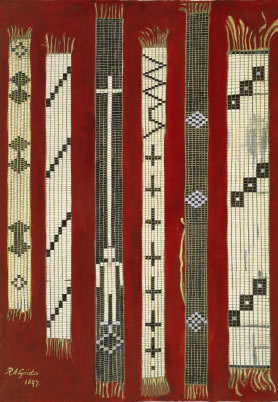
These are Haudenosaunee wampum belts that serve as their historical documentation. The “Jesuit belt” is located third from the left. There is debate concerning the exact meaning of this belt, but some Onondagas interpret it as reflecting the arrival of the Jesuits to Onondaga in the 17th century. Using such evidence will be particularly challenging for students.

In creating a public facing digital project, I will need to work with students to move from writing traditional papers to create interpretations that are still historically sound, but also be much more concise than they’re used to as well as having visual and audio elements. The last two are still a challenge for me. I envision a digital map showing key areas in the story of Onondaga and Jesuit relations as well as how their histories developed somewhat separately. Short student videos? Podcasts? I have a clearer idea on using digital media to gather evidence, but will still need to think more about the final digital project, which I think should be geared towards other Le Moyne students as well as faculty, staff, administrators, and our campus Jesuit population who are still upset that Ste. Marie Among the Iroquois is no more. As I said in one of my earlier posts, inertia is a powerful force, and trying to get myself to change course at this point in my career is challenging, even if I am a most willing participant.

The History of History Teaching

Through the 20th and into the 21st century, historians have maintained certain elements of historical thinking as crucial to the teaching of history. Ideas such as being able to recognize the “foreignness” of the past, and the ability to understand and articulate chronological causality have remained key elements of teaching students how to think historically. Most significantly, historians have maintained, although expanded, the need for history students to learn how to deal with evidence. They should be able to tell the difference between primary and secondary sources, they should be able to “source the source” and assess the sources value as historical evidence, which is different than reading the source merely for information. They should be able to use those sources as evidence to create an analytical argument or historical narrative. These ideas seem to be consistent as necessary skills for students to learn to think historically. Lofty and noble goals.

What has also remained consistent is a focus on content as well as process, and while so many historians and history teachers discuss the importance of teaching and learning the process, we still tend to focus on testing on content knowledge. And, as I have learned in the readings, students assessed content knowledge has remained pretty dismal over the same period of time we as a profession discuss the importance of process. Much of this consistency through the decades seems to be related to a continued reliance on textbooks that provide lots of information with little integration of process. Here is the story of what happened, and then there will be a separate page with a highlighted primary source document that may have a few questions for students to consider. There is not, however, any true connection between the primary source and the process of creating the textbook narrative.

I have to say I was rather taken aback in Wineburgs’s discussion of national testing and how certain questions and items end up on tests because they work mathematically to make sure a basic bell curve is maintained for test scores. Between a focus on content and rigging tests so that they cannot show how students think historically, it paints a depressing picture for the next 100 years of historical teaching.

So what is the future of the teaching of history? I do not see a day in the near future where k-12 schools, or college classes for that matter, throw away the text books and look to a curriculum focused on the historical process. Inertia is a powerful force. Policy requirements and hostile school boards are also powerful forces. Textbook publishes and testing agencies want to protect their place as well. I am fighting against the forces of cynicism myself, but I’m not sure who is winning at this point.

First piece of the puzzle

In the fall semester 2022, I will be teaching “Introduction to Public History” to 20 undergraduate history majors. This will be my first time teaching this course. I have a good draft of a syllabus already done, and that includes a student project on historic monuments in Syracuse. Here is the way it is currently described in the syllabus:

” Syracuse is home to several historic monuments. Students will research a monument to answer questions of who erected it? Why? When? What does it mean to people in the area today? To answer the last question, students will conduct at least one on-site observation as well as interviews.”

Yes, this is as far as I’ve gotten. I think I would like to focus on this as a project for this semester. How can I more fully develop the project to get students really thinking historically about the context in which those monuments were constructed. That is key before we really get into the role they play today.

One of the biggest primary sources should be historic newspaper accounts that, hopefully, describe the unveiling of the monuments. I will also want to locate organization records concerning some of the monuments. For example, the Knights of Columbus and the Columbus statue that is currently a point of contention in the city.

My audience is my class for right now. Their audience will be the general public of Syracuse, but for my purposes in creating the basis of the assignment, I need to focus on my students and getting them to be able to tell the story of these monuments through historical thinking.