Thoughts on thinking about historical thinking

I have been “teaching” history to undergraduates in some way for over two decades now. I have experienced what many of the scholars discussed in going from the performer on the stage to trying much more “student-centered” approaches to history. My experience echoes the tensions in the readings. When I lecture, and I have to admit I am pretty entertaining, only a few students seem to care. When I use more active techniques, students mostly feel overwhelmed. I have felt stuck for a while now. Much of the stickiness also comes from trying to negotiate the expectations of our history classes, particularly in the core curriculum. That expectation focuses on content. Students need to know World History to be good citizens of the world. Sure, I agree, but they’re not learning it in our classrooms. Part of the requirement for World History class is to write a “research” paper. I put research in quotes because while they all write a paper, none of them doing history. But we pat ourselves on the back for our efforts, complain about their lack of knowledge, and then repeat the process again.

I have tried to stop this cycle in my classrooms by breaking the rules of expectations (thank goodness for tenure). While I never really thought about or read about the theories of teaching history, I realized that thinking historically did not come naturally to students. Context has no real meaning. I decided the survey format was not useful. I began utilizing Reacting to the Past games in my class. Students were definitely more engaged; I had to stand between Lafayette and a Jacobin in a game on the French Revolution. But they were still struggling understanding the documents let alone understand them in context. Making that jump from reading the sources to truly understanding them in their context, the heart of historical thinking, was the challenge. Fun was being had, but what were they learning? I’m still not sure.

That gets me to the idea of assessment. While my institution did not get denied accreditation because of our lack of assessment, we were put on probation and had a year to turn it around. We fill out the paper work. Send it to the assessment guru. They tell us we’re doing a good job now. Then we pat ourselves on the back for our efforts, complain about students’ lack of knowledge, complain about assessment, and repeat the process again.

So, where am I headed with this? Getting my students to think historically has been my biggest challenge for years. I have had more success with some history majors, but not all. But, as many of the readings discuss, we have to actually be able to articulate why we should study history at all. For academics, it’s clearly important, but we haven’t succeeded in getting buy in from students, their parents, and, to be honest, some administrators.

Some questions I will be considering for this class.

  1. How do I get students “unstuck” from their bottlenecks? As the video on threshold learning discusses, I need to first really recognize where that bottleneck begins and then develop some key tasks that can be assessed (not whatever it is we do now) to get them closer to historical thinking.
  2. How do I get students to value history as something worthwhile to study? Wineburg stresses the importance of thinking historically as a way to achieve a greater understanding of our own humanity. I agree. Students? Hmmm. I will have to think more of what I have tried and what I can do differently.
  3. How do I get students to become more historically literate in this digital age? Information literacy is a big part of our new assessment program. Students take some tutorials. Take a quiz. Then move on. How do develop a better plan for students to be critical of documents? I will be checking out the “reading Like a Historian curriculum as mentioned by Wineburg and Reisman.

Despite being in mid-career, I very much feel like I’m starting over. Wineburg is right, history professors don’t search out articles written by psychology folks on how to teach history. I’m hoping this not so new but new to me information can help get me past my own bottleneck.

HIST 689 Intro post

Greetings! I am Holly Rine; I am an Associate Professor of History at Le Moyne College in Syracuse, NY. My interests and goals in the Digital Public Humanities certificate program are to gain skills, primarily, to teach undergraduates about digital public history. I have an M.A. in Public History/Cultural Resources Management, but it is from 1994. Since my degree pre-dates the introduction of Windows 95, I figure I have some catching up to do in all of public history but particularly in the digital part. I am especially excited about this class as I hope it will give me some solid grounding as I prepare to teach an Introduction to Public History course come fall 2022.

As many in the class have heard, ad nauseum, I am hoping to create 1. a public history concentration in our current history major, and 2. a digital project for students to work on that will focus on local history, the tentative title of which is “Syracuse at the Cross-Roads.” My project last semester was a site built with Omeka that tells the counter-narrative to what in Syracuse is known as the “Jerry Rescue,” which was the rescue of a fugitive slave from federal custody in 1851 in the city. This is the cornerstone of Syracuse’s public memory as an abolitionist city. My project was designed to tell the other part, where most Syracusans found the abolitionists to be both dangerous and treasonous. I used this as a pilot of sorts for the “Syracuse at the Cross-Roads” project.

In addition to improving my skills with Omeka, I also want to learn more about creating interactive maps, podcasts, and oral histories. Like my “traditional” history teaching at Le Moyne, I cover many subjects from Native American History to Environmental History and World History, and, given our hiring freeze, I will need to broaden my skills in digital public history as well. That is before the teaching part even comes into play. Luckily, I learned the key lesson that you need a team to do this kind of work, and, luckily, I have many colleagues who are also interested in contributing their skills to this project. I am excited for this opportunity to shake up my own work as well as bring some new ideas and projects to my students and colleagues.

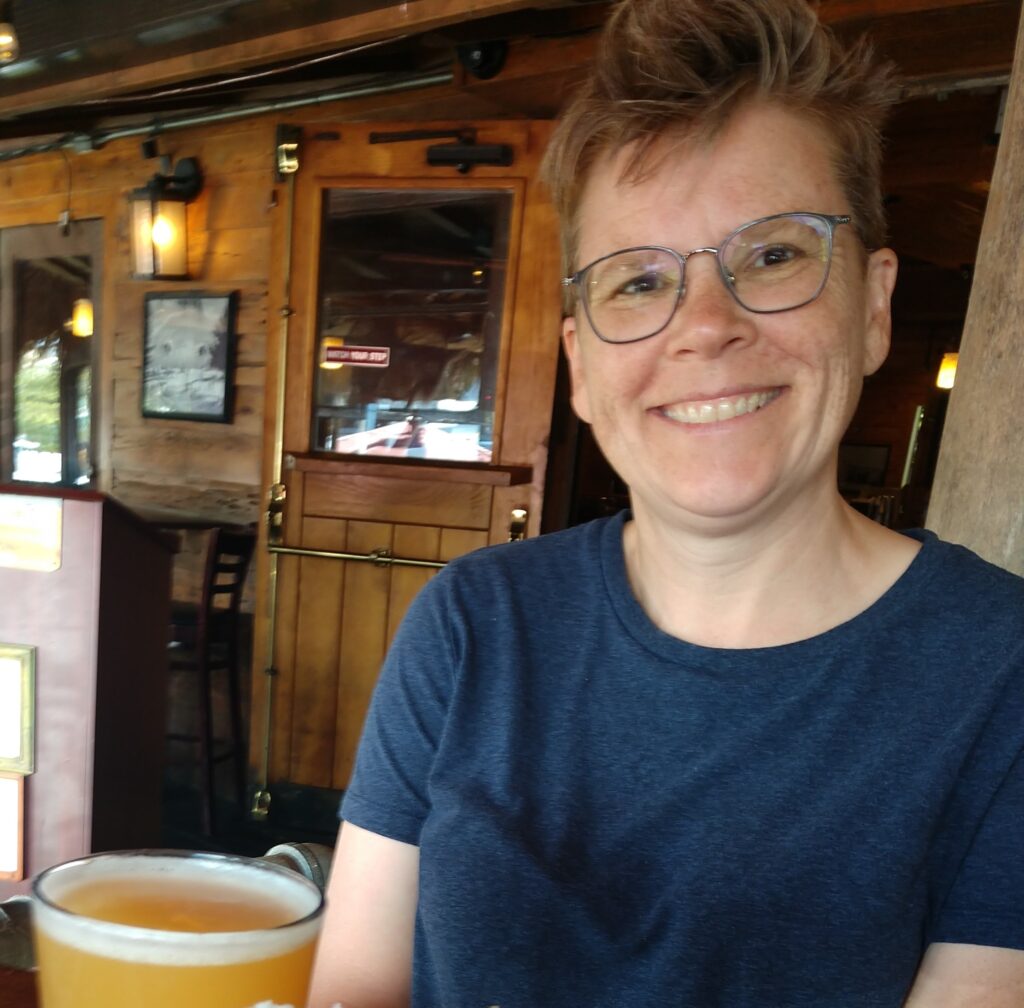
I’ve also discovered there aren’t many photos of me without a dog or without me making strange faces or both. Here is one of the few, when my wife and I escaped Syracuse in January for five, warm, sunny days in Sarasota.

Final class thoughts

This has been a wonderful learning experience. Yes, I learned many skills in digital tools and online presentation. I expected to learn that, and I am grateful. However, I also learned about the importance of collaboration and how to handle frustration with technology and when the learning curve gets steep. These learning experiences will be most helpful when my students experience them as I start teaching public history and incorporate digital elements into their projects.

I reached out to both Dr. Kelly and classmates on several occasions and their help was the only way I was able to get past some problems I was having. In learning the very basics of audio recording for podcasts, not only was Dr. Kelly most helpful, but I am actually getting instruction from one of my undergraduate students in recording and editing. I was hoping to have a short podcast as part of my class project, but that learning curve was more of just a straight climb up to start with. I will be working on it over the summer though.

These are just a few of the learning experiences I did not expect but am glad to have had. I will remember those moments when my own students are a bit lost and confused. I will also be ready for those same students to come up with the answers to questions and problems that continue to frustrate me.

Project goals and evaluation

The main purpose of my digital public history project “Syracuse Treason!” is to provide a counter narrative to the one that holds in current historical memory that ante-bellum Syracuse was a city dominated by abolitionists. While it is true that many abolitionists lived in and visited the city and its surroundings, most Syracusans were at best ambivalent towards the abolitionists at worse they were downright hostile to them. This story of the Syracusans who spoke up against the abolitionists as dangerous is often ignored, but by looking at the actions of city residents in the wake of what is known as the “Jerry Rescue” allows for the full picture to be revealed. Many prominent citizens and even more common ones rose in defense of the enforcement of the Fugitive Slave Law of 1850 and saw those who rescued Jerry from being sent back to slavery as required by the law to be guilty of treason. They viewed the abolitionists as trouble makers that stained the reputation of the city of Syracuse from a law abiding community to one ruled by mob violence.

This is not necessarily the story many in Syracuse would like to hear. By focusing on the rescue of Jerry the fugitive slave from the clutches of over reaching federal forces, the city has maintained the memory of Syracuse as an abolitionist city, but it is not the whole truth. The next step I would like to take with this project is to look at the process of erasing the anti-abolitionist story from the city’s history. I remember reading Joanne Pope Melish’s 1998 monograph Disowning Slavery and coming to the realization of how well New Englanders had erased the history of its slavery past and how that erasure became a key part of New England social memory. Similar stories can be told in other places through the North, including Syracuse. Moreover, the should be told to help us understand the continuation of racist attitudes and policies in the heart of what was abolitionist territory.

Here I will admit that I am very happy that there are people on campus who not only know more about the assessment and evaluation of goals and objectives, but they enjoy it more than I do. I know it is an important element to any undertaking like this, but I will be glad to have some help with this aspect. Unfortunately, our online learning rubric/assessment guru had Covid when I asked to talk with him, but I now realize that to move the “Syracuse at the Cross-roads” project forward he will have to be a key member of the team.

For the moment, I believe that the two biggest factors to show that the project met its goal to reach its target audience (current and former residents of Syracuse/CNY) would be indicated through tracking the number of unique visitors to the cite. However, sheer numbers only tell part of the story. The bigger goal, to get that audience coming back, sharing the cite, and engaging with content creators and other visitors, would have to be evaluated through both quantitative measures (how many people are coming, how many shares, how many comments), but also through qualitative assessment of HOW they are engaging with the site. What types of comments are visitors leaving? Are they asking questions? Are they engaging with one another? Of course, like the bright student in class who never speaks, I wonder how we could figure out if and how well we are reaching that crowd as well. I will be discussing this with my online learning /rubric assessment guru soon.

Digital Public History in 2022: What Would Laurel Thatcher Ulrich do?

For this post, I cannot help but think about how some of these new technologies would have affected the creation of Laurel Thatcher Ulrich’s Pulitzer and Bancroft prize winning book, A Midwife’s Tale: The Life of Martha Ballard Based on Her Diary, 1785-1812, published in 1990. I have used this book to teach undergraduate history majors how historians do what they do. I use this book primarily because there is an accompanying website, dohistory.org (which I just noticed this semester that the site is hosted by the Roy Rosenzweig Center for History and New Media at GMU,) that provides the reader with the actual documents that Ulrich used to create her book. This includes a digital copy of the diary upon which the book is based. One can read the diary in its original form (18th century handwriting and spelling included) or one can click a button and get the text in nice modern computer type (the 18th century spelling is still there.) The search function kept giving me an error message though. It also splits these documents up into broader topics that Ulrich dealt with in her book. There is also a film that goes along with the book. The site itself is a nice example of digital public history that allows several different audiences to engage with the text and its creation.

In watching the film with my students, some were confused by the scenes of Dr. Ulrich “making sense” of the diary by having a large sheet of paper with different topics, people, and places listed on it and how she was going through the diary and circling these different pieces of information and making these connections of who was where and what they were doing and how all this changes from 1785-1812. You can see an example of this as the background to the introductory page to the book on dohistory. A student asked “isn’t there an easier way of doing this?” I wanted to give my Tom Hanks in A League of Their Own answer and say, “it’s the hard that makes it great!” I did not give that answer. Instead, I said, “yeah, I would think there is.” Of course, the questions remain, and the reading, and the notetaking, but in finding those connections, it seems if Ulrich had access to network analysis tools, if she could have uploaded that information she collected and find those connections between people, places, and events. I will freely admit that I am a novice at best in the digital world, but it does seem that the technology exists where maybe an update to the dohistory site can show how the same analysis work could be done and illustrated graphically. Of course, if I was Ulrich (wishful thinking there) I am not sure how I would feel about that.

I also thought of her work because we can now see the value of getting the stories of under represented populations out through public history projects and allowing a broad audience to participate in the creation and understanding of historical knowledge through more than reading books. I was particularly taken with the Lowcountry Digital History Initiative project. Like dohistory, the LDHI is housed within an academic setting, in this case the College of Charleston. Unlike dohistory, the LDHI also partners with numerous other academic institutions as well as public history organizations and community organization. This approach allows for the project to continually grow with new exhibits and partners. It also provides the ability of the community to get engaged to uncover histories that may never be known. How many scholars looked at Martha Ballard’s diary and said “meh, nothing here” until Ulrich recognized the significance? How many stories would not be known without the historians asking and listening to “outsiders”? The technology allows for greater reach in sources and audience. The challenge may come in limiting what one is doing as a digital public historian so as not to create a hodge podge of information without a clear purpose or narrative.

Jerry Rescue Project Update

The month of March was “interesting,” and, well, I only have one update to post for the entirety of the month. Our class meeting on March 10 had me rethink the focus of the project to the point where I realized there wasn’t a really good focus, and the project wasn’t all that new or interesting. So back to the drawing board I went. Luckily, spring break was the next week, and I was able to take advantage of the Onondaga Historical Association’s research facility, which is open mostly when I have class and other obligations. March 16-19 I was able to go through the OHA collections on the Jerry Rescue and develop the new focus for my paper. The sources revealed a contest to control the narrative being played out in the local newspapers and picked up by newspapers around the country. The Syracuse Star gave voice to the “law and order” crowd who wanted the “Syracuse rioters” punished for treason in defying the Fugitive Slave Act by rescuing Jerry and sending him to freedom in Canada. The Syracuse Standard was the main voice for the “higher law” group who wanted the “Syracuse rescuers” raised to hero status and those who arrested Jerry to send him back into slavery in Missouri punished for kidnapping.

The story reveals that while Syracuse was increasingly becoming an abolitionist city, a large part of the population, including many of the political leaders, saw the defiance of federal law by the increasingly vocal and active abolitionists as dangerous for the city and country. The sectional crisis was not just sectional but also local. So I went even further back to the drawing board. I rethought my personas, and I am reworking my storyboard as well. My original intent was to create an interactive map focused on the rescue using ArcGIS StoryMaps. Now I will be concentrating on Omeka as the platform and will be including relevant newspaper articles and photographs of key players. I intend on including a map that will show the continued legacy of the events of 1851 on the Syracuse landscape that will include the “Freedom Trail” sites that highlight the abolitionist activities, as well as the prominent place names associated with the “law and order” group.

My biggest challenge now is jump starting again. What I had put into Omeka no longer applies. So I have to choose from the many newspaper articles and get those up on Omeka with the proper metadata. Then I go from there. Suddenly writing a 30 page article seems like a walk in the park. Back to it!

History Pin & Hawley Green

I checked out Historypin as a way to explore place based digital public history projects, which is something I’m quite interested in. I found an exhibit based on the historic Hawley Green neighborhood in Syracuse. The neighborhood has been the target of historic preservation projects for some time, but with little success thus far. It sits on the border of downtown (it was on the north side of the Erie Canal and, when the canal was there, downtown was on the south side of the canal) and a hospital complex. The neighborhood has experienced great economic decline in the second half of the 20th century and into the 21st. It is also considered to be the “gayborhood” of Syracuse, but there really is little evidence of that on the landscape or in the collection.

While exploring the site on my computer, the technology showed some promise. There are only 16 photographs, but they do highlight the architectural importance of the neighborhood with examples of domestic, business, and community/social structures. The main focus of the site is the architecture, not necessarily making larger historical contexts. By clicking on the individual photographs, there is a historic photograph superimposed on a current photograph of the address. You can then remove the historic photo to see only the current one. There is also a brief architectural description. The initial view of the superimposed photo over the modern one is a bit awkward and, as they may say on the Great British Baking Show, clumsy, but it is an interesting juxtaposition. After reading the article on augmented reality applications, I see the idea behind what the technology can do, but it seems to have a ways to go in making it more visually appealing.

Then I grabbed my phone and headed down to Hawley Green. Well, my hopes for promise were a bit dashed. Full confession, my phone is several years old so was part of the problem, but it was difficult to navigate the site using it. In initially searching for the site, search boxes were cut off, and if I hadn’t already loaded the specific site onto my phone prior to leaving my house, I’m not sure I would have been able to find it while outside. Also, it is Syracuse, and it is still cold. Taking my gloves on and off to navigate was a bit annoying after a not very long time. When I did get into the site, some photos included the superimposed image, while others did not. I preferred the later. At that point, I can see the current structure, and the 360 degree scrolling just seemed like a distraction. It was nice to learn a bit more about some of the specific buildings, but I’m not sure I would venture out specifically for this kind of experience again. Oh, and some of the historic photos are sideways. That should be easy to fix, I would think.

Bowlingirl214 created this collection back in 2015 stating it is a work in progress. Well, some changes have occurred in the neighborhood since then, but there doesn’t seem to have been any additions or updates to the site in the past seven years. I would imagine the time to create and maintain such a site would be significant, so I cannot blame bowlingirl, but still, it was a bit disappointing given that she stated it would be a continuing project to assist in the various revitalization efforts focused on the community. I will have to take a look at some more recent projects to see what the potential could be and how the projects have evolved in the past seven years.

“Syracuse at the Crossroads:” Digital Public History at Le Moyne College

Syracuse, NY sits at the conjunction of US Interstates 81, which travels from the Canadian border to the state of Tennessee, and 90, which starts in Boston in the east and ends in Seattle on the west coast. Likewise, Syracuse has found itself as a meeting point of many significant moments and events in US history. Before I-90 there was the Erie Canal around which the city grew and on which good and people from NYC and Buffalo and beyond traveled. Before there was the Erie Canal, there was the main trail connecting the Five Nations of the Haudenosaunee Confederacy. At the center of that Confederacy is the Onondaga Nation and the site where the Peacemaker brought the nations together, Onondaga Lake, upon whose shores the city of Syracuse was established. Its geographic centrality contributed to the area’s historical significance, which this project will explore. How did it become the center of the Haudenosaunee Confederacy? What happened during the American Revolution? What about now? Why does Syracuse become a destination for fugitive slaves? What were their lives like in the city? What happens when slave catchers came looking? What is the immigration story of Syracuse? Why is there an upside-down traffic light in the Tipperary Hill neighborhood? How did the immigration story change? When and why does it become home to refugees? Where and how do they live? How have they helped the city grow? Oh, and that I-81 goes right through downtown and has been connected to the fact that Syracuse has one of the highest levels of concentrated poverty for communities of color in the country. What happened when it was built? Who were the winners and losers in that infrastructure project? And what about Onondaga Lake, which at one point was the most polluted lake in the United States? This project will explore these questions and others of importance to the region.

“Syracuse at the Crossroads,” created by and maintained by faculty and students at Le Moyne College, will utilize GIS technologies in order to create a geographic understanding of the development of the city and how the space and place of Syracuse affected events. To understand the Jerry Rescue, the rescue of a fugitive slave arrested in Syracuse in 1851, it helps to have an idea of the layout of the city, as well as his route out of the country. It also helps to know how a man born into slavery in NC, escaped that institution in Missouri, and made his way to Syracuse, NY. Mapping is key. Furthermore, there are dramatic stories to tell and that lend themselves well to a podcast format. So along with understanding the geography of the Jerry Rescue and other important events, Syracuse at the Crossroads will offer its audience audio narratives that can explain the significance and convey the human experience of the events by interviewing scholars and community members.

According to US census data Onondaga County is home to just under a half-million people. Of that population, 88% have computers and over 80% has access to broadband. This population will be the main audience for the project for people to 1. Learn more about their history and 2. Hopefully work with the project to help tell the stories. In many ways Syracuse at the Crossroads isn’t just about Syracuse, but it is for Syracuse. Furthermore, like many Rust Belt cities, Syracuse has seen its population decline starting in the 1970s and 1980s as the economy and its residents headed south and west. These people often still have family in the area and a strong emotional connection. This project is also for them and about them. For both communities, this project can offer a greater connection to a community they live in and identify with.

Persona: Allison Dolz

Name: Allison Dolz

Demographic: 28 year old woman

Descriptive Title: Public Administrator for City of Seattle Fire Dept., former resident of Syracuse, NY

End Goals: Technology such as podcasts and digital sites are good for staying connected to interests when you are unable to actively be doing what interests you.

Quote: “Let’s go outside.”

A Day in a Life Narrative: She has a Masters in Public Administration and a BA in Political Science and Environmental Studies. Allison works for the city of Seattle Fire Dept and maintains a schedule that will allow her a three day weekend every other week so she can go out hiking as much as possible. She takes public transportation to work and listens to news and podcasts on her phone while doing so. This is similar to about 33% of her age group. In fact, she is in the highest categories of those who get news from podcasts in the categories of age, level of education, and salary. Although she used to find Joe Rogan amusing, her point of view has changed. Allison uses technology as part of her job and as a form of news and entertainment. Her recollections of Syracuse and upstate New York revolve around outdoor experiences of hiking, camping, and biking in the Adirondacks and Finger Lakes. She also mentioned food quite a bit as well as attending protests and social action events concerning race relations and the environment. She has a feeling of nostalgia for Syracuse now that she has been living away for about 6 years. She likes to relive with friends the fun times of hiking in the area and going out to eat and walking downtown when the weather was nice.

End Goals: Technology is a good way for staying connected to your distant friends and your interests when you are unable to actively be together and participating in activities. It’s especially good on the rainiest of Seattle days when you have to stay in.