Content, Audience, and Shared Authority in Public History projects

The most exciting aspect of the relationship between audience and content in public history projects is active audience participation in the creation of the work. As discussed in the articles, “Whose Public? Whose History?,” “Creating a Dialogic Museum,” “A Shared Inquiry into Shared Inquiry,” and “From a Shared Authority to the Digital Kitchen and Back,” creating public history projects is not just about creating a product for a consumer, but it is also about working with the public to create their own history.1 It is collaboration between many entities: historian, audience/subject, technicians, designers, etc. The first time I encountered a public history project that explicitly took the needs, views, and ideas of the audience and subjects seriously and as the main focus of the entire project was the District Six Museum in Cape Town, South Africa in 2007. I had never seen a museum that centered the first hand accounts, memories, and artifacts of the people whose story was being told. It was truly their museum and not just a museum about them. Many historians I spoke with didn’t like the museum because for them it lacked a coherence and a scholarly voice. The scholarly “authority” was missing.

This visit and the subsequent discussions of the museum with other historians is what I thought of when reading Michael Frisch’s distinction between “sharing” authority and “shared” authority.2 The academic historian typically sees herself as the one with the authority that she can choose or choose not to share. The public historian must recognize the authority within any project is not theirs to share but is inherently shared by all interested parties. This remains a difficult concept for academic historians and seems to be reflected in the Journal of American History’s review guidelines for digital projects. There is no call to discuss and evaluate that shared authority.

Even when the project isn’t directly involving the public in gaining access to content, such as oral histories or the collections of the District Six Museum, the public historian has to carefully consider how the public engages with the content. The “public” is a pretty broad category, so more thought has to go into who will be engaging with the project and how they will be engaging with it. The document “Building Histories of the National Mall: A Guide to Creating a Digital Public History Project” was a deep end experience for me in what goes into the planning of a digital project including who has access to technology, how do they engage with that technology, how to make the tech experience not over shadow the content experience, and just how many people are involved in such a project. This is NOT your lone historian in the archive approach to history. Then comes the user research and persona creation. I will admit, this is not what I thought I would be doing in learning to create digital public history projects. While I am still confused by the entire process, I am aware enough to realize without this work, my project may appeal to just me and a few other people, one of whom will be my father, so that doesn’t count. Having spent the majority of my professional career easily defining my audience as either students or other academics interested in my small corner of the historical world, I find the user research and persona creation to be quite daunting. However, it is clear to create a public history that is for, about, and with the actual public and not just the single historian and a limited audience, such work must go into the foundation in order for the structure to stand.

  1. Katharine T. Corbett and Howard S. (Dick) Miller, “A Shared Inquiry into Shared Inquiry,” The Public Historian 28.1 (2006): 15-38; Michael Frisch, “From A Shared Authority to the Digital Kitchen, and Back,” in Letting Go?: Sharing Historical Authority in a User-Generated World, edited by Bill Adair, Benjamin Filene, and Laura Koloski, (Philadelphia: The Pew Center for Arts and Heritage, 2001), 126-137; Ronald Grele, “Whose Public? Whose History? What is the Goal of Public History?” The Public Historian 3.1 (Winter 1981): 40-48; and John Wei Tchen, “Creating a Dialogic Museum: The Chinatown History Museum Experiment.” In Museums and Communities: The Politics of Public Culture, edited by Ivan Karp, Christine Mullen Kreamer, and Steven D. Lavine, (Washington, D.C.: Smithsonian Institution Press, 1992): 285-326.
  2. Frisch, “From a Shared Authority” 127.
User Research

Audience! This will be a challenge for me. I have spent more than a couple decades in academia, so my audience has been easy: students and other academics. Even when I worked in cultural resource management, my audiences were the Keeper of the National Register and the WVDOT; they were easy to define, but they were not easy to satisfy equally. Anyway, now I am tasked with discovering a public audience and what they are interested in, which, shockingly enough, may not be what I am interested in, which is a shame, because I have some great interests. Furthermore, I learned that even those who may share my intellectual interests I’d like to pursue in the project, he/she doesn’t necessarily care for the digital format. Likewise, one who is keen on podcasts doesn’t seem to share my personal interests. Now these are just two people, but just with these two, I see that I am going to have to think much more clearly about my audience and how to meet their needs while maintaining my own goals and objectives.

Comparative review of Skanonh Great Law of Peace Center & Website

Comparative review of Skanonh Great Law of Peace Center located at 6680 Onondaga Lake Pkwy
Liverpool, New York 13088 and its website found at https://www.skanonhcenter.org/. The site is owned and operated by the Onondaga Historical Association & the Onondaga Nation.

I believe I should start with a disclaimer. I am a member of the academic collaborative for the Skanonh Great Law of Peace Center since its beginning. In that capacity I was one of several members of the local academic community with interest and expertise in the area of Haudenosaunee history and culture who worked to develop interpretive material for the physical site. However, my involvement has decreased through the years, and once the pandemic hit the collaborative didn’t really meet. In the meetings I attended we never really discussed a web presence.

The Skanonh Great Law of Peace Center’s main objective is to tell the story of the Onondaga people from their own perspective. The space immediately sets the tone by having the patrons listen to and watch videos of members of the Onondaga Nation welcome them, the work Skanonh is an Onondaga greeting meaning “peace and wellness, and then listen to a thanksgiving address with the explanation that such an address is recited at the beginning of any public event. This is to put visitors in the frame of mind of the Onondaga people. I find it an effective way of drawing people in and orienting them to, what is for many, a new perspective.

The audience seems to be a general, somewhat older, non-Haudenosaunee visitor. My spouse and I were the only ones in the museum at the time of the visit, so I am not sure who comes. Syracuse is not a really big tourist destination, especially in winter, so it seems that most visitors would be more local. I know they encourage school groups to come to the museum, but I do not know what special programming or experiences they share with school children.

The museum then takes the visitor through a thematic and somewhat chronological exploration of Onondaga history staring with creation stories, explaining the Great Law of Peace as a unique and central focus of all Haudenosaunee peoples, the Onondaga experience with European contact, and Onondaga continuance of culture and history today.

The story is told mostly through reproductions of historic sources, original artwork in the form of paintings and sculpture, and some original artifacts. These visual aspects are accompanied by textual explanations and context development. The section on contact in particular tries to reorient the viewers to an Onondaga perspective when learning about the impact of the Sullivan Clinton campaign during the American Revolution or the experience Onondaga children went through at the Carlisle Indian School.

The flow through the museum works well in moving the visitor through the story, which is good as, like so many places, they are understaffed and docents are not usually available to guide visitors unless a tour is prearranged. The staff member present, however, was very knowledgeable and willing to answer any and all questions. There is an outdoor element to the museum as well, but it was a 15 degree day with wind blowing off the lake, so we did not want to brave that part.  

There is also space dedicated to temporary exhibits that feature the work of indigenous artists. The current exhibit by Mohawk artist Tom Huff takes on the issues of Indian stereotypes in advertising and marketing, entertainment, toys, and sports. This again helps the non-Indigenous viewer to understand the issue from an indigenous perspective and see it as not as “harmless” as such visual depictions are often described. This is particularly timely with the renaming of the Washington football team from a racial slur to the Commanders. With Covid, there has been limited ability to bring in more temporary exhibits, but they are a welcome part of the museum and allows for a space for Haudenosaunee peoples to tell their own story and create their own history. It is what makes this space truly unique.

Interactive elements are limited in the main museum. Most of the experience is in reading, except for the welcome and thanksgiving address. I personally would like to see more interactive elements. I find it hard to stand and read for long periods of time because of back issues. We all know children are not interested in that at all. Pre-covid the museum did host a wide variety of events at the site, which made it a much more enjoyable experience. There was an annual wooden stick lacrosse festival, art shows, talks, workshops, kids programing etc.

One other odd element of the museum is that it shares space with the Onondaga County Water Authority. This was a stipulation when the country transferred control of the space to the Onondaga Historical Association. It doesn’t take away from the story being told, but that space could be utilized for other purposes. I would particularly like to see more interactive elements. Oh, and more places to sit through the museum. While there is an elevator for ADA compliance, there are just not enough seats, even for a nearly empty museum.

Unlike the physical museum, the web presence for the center is much less welcoming. The home page is a welcome from the director, who is unnamed. When a viewer goes to the “about the center” section, he or she will get an explanation of the meaning of Skanonh, but it is much less effective as a way of drawing people into the site as the videos with which visitors are greeted at the center itself. This is a shame as I find that welcome and the thanksgiving address videos at the museum itself to be a wonderful way to draw people in and illustrate the idea that we are all connected. The “about” section provides a clear purpose of the center which is tell the history of the Onondaga people through the lens of the Onondaga people. This section also explains the sacredness of Onondaga lake where the center is located, but it doesn’t actually mention the centers location. It makes sense if you are from the area, but it seems a bit disconnected if you are not.

The “exhibits” gallery also provides the mere basics of what the center covers with a single photograph and description of the five major themes of the center: welcome, Great Law of Peace, creation, contact, continuance & contribution. Unfortunately, this is where it ends. Although I see that a viewer can see the use of audio/video technology at the museum in the website photos. Each segment gives the viewer an idea of what he or she will find upon coming to the physical site. It is the same format for the description of the temporary exhibits.

Prior to the pandemic, the museum was the site of many programs including talks, art and craft shows, lacrosse tournaments, and workshops. There is a small list of some of the past programs, but no links to videos of past programs, just the description.

After this the rest of the information on the site includes information on tours, hours, and admissions as well as ways to donate or items to purchase from the gift shop. Sadly, the “news and events” section has not been updated in two years. The website clearly encourages the viewer to go to the physical site to experience Skanonh, but it seems that even in this regard they are missing out on opportunities. Greetings and thanksgivings always start and end public gatherings for the Onondagas, the physical site illustrates this, it seems including just these elements would be beneficial to getting people more likely to come to the museum itself, especially as we, hopefully, move out of the pandemic to a time where we can gather again in safety. It seems like a great opportunity missed.

Doing Public History Introductory Post

I come to this class having been teaching at the college level for almost 20 years now. I have about 20 more to go before I, maybe, can retire. This program is a bit of a mid-career shake up as I hope to develop a public history concentration to the history department at Le Moyne College where I work. I think this will be of service to our students, and I am also hoping that it will put a little life back into my own research, writing, and teaching.

I am not necessarily new to Public History. I have a M.A. in Public History or Cultural Resources Management or Historic Preservation (there was a bit of a debate going on at my institution as to what to call the program when I was there.) I then worked as a “Historic Preservation Specialist” for a few years in the Cultural Resources section of a major engineering firm in Pittsburgh. I did a lot of field work and report writing for cultural resource segments of environmental impact statements for road projects. So it was not necessarily even the public history that those who have heard of public history think about. Our main client was the West Virginia Dept. of Transportation. Now that I have an idea about writing a persona, I’m wondering what exactly that would look like in this context.

I did decide to move on from that work and get a Ph.D. in “traditional” history. Now 20+ years later, I look to return a bit to the Public History realm, and realize I have missed a lot in that time period. If I am going to teach this to students who were not even born when I left my CRM work in the 1990s, I better catch up. The most challenging part, and hence my enrollment at George Mason, is the digital development in the field. I know it as a consumer of content, but making that content? That’s another story. I hope to learn as much as I can about how to create historical content for the public and online. I know I am interested in creating web sites, working with mapping tools, and possibly trying my hand at podcasts. Our work in the introductory class last semester has given me a good idea of possible projects and programs, along with their particular benefits and challenges. It was an eye-opening experience. Likewise, I am looking forward to learning about opportunities and possibilities specifically in digital public history that I haven’t even thought about yet.

Reflection on the project

My aim for this project was to begin to investigate how I could use travel narratives to help understand environmental history, particularly of the Upstate NY and Great Lakes region. I chose this because I have moved into environmental history as of late with a focus in this region, which is also where I live and work. I am also hoping to create opportunities for my students to work in the history of current local environmental importance. My aim remains the same, but HOW to exactly go about this has caused me to pause.

I chose travel narratives because they do offer observations of the natural world. The narratives range from 1653 to 1852 including a chapter of a volume from the Jesuit Relations, a narrative from naturalist John Bartram, a narrative from a European explorer in 1818, and the journal of a missionary in 1852. Although they did not help me to really answer any historically significant question regarding environmental history at this point, I believe they can. I also like the idea of using sources in creative ways. I talk about that in the opening of my project. There are also many narratives out there, so it seems that there is a large enough data source to help answer some questions.

I believed the best way to go about this experiment was through using Voyant for basic text mining to see upon what the authors were most focused. This was not so helpful in gaining insight to their environmental observations, but it did give me ideas in how I can teach students that although a source doesn’t cover exactly what we are looking for, it doesn’t mean it is not a valuable source to help answer questions. I believe there is more I can do with the text mining tool, however, as a way of exploring changing attitudes over time, but that was not the intent of this project.

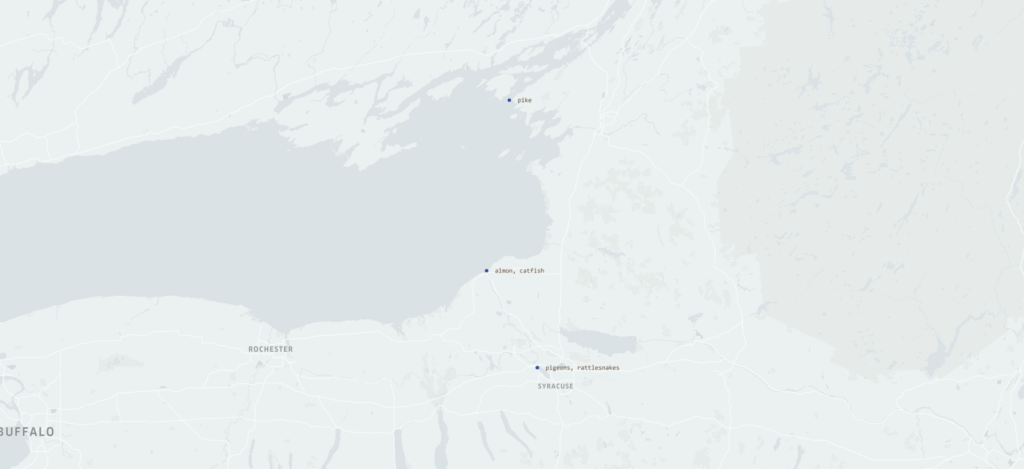
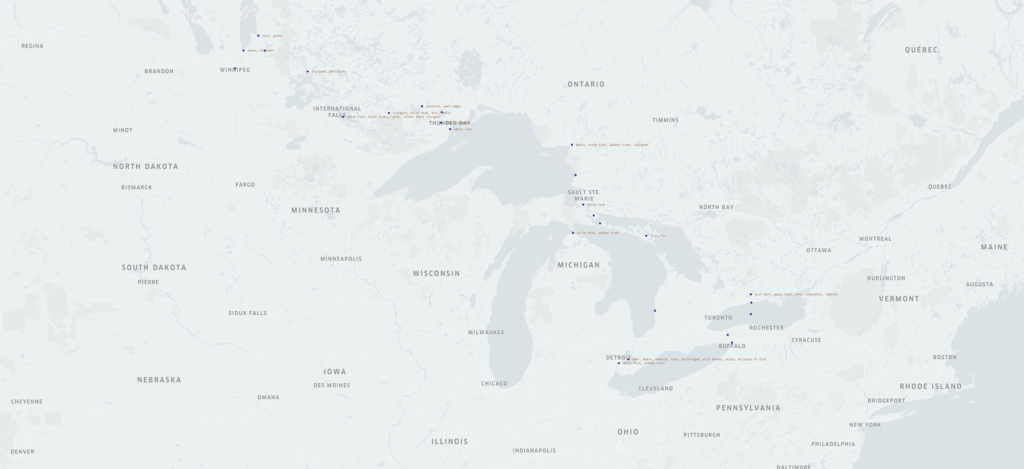
From there I went through the sources to gather data on locations of flora and fauna as observed by the authors. The 1852 journal was probably the “best” source for ease of gathering that data. Place names were clearly presented along with descriptions of animals, trees, and plants observed. I was able to create an excel sheet and then convert it into a csv file to upload to kepler. Just the fact that I did that is a big step ahead in my digital knowledge. It was a very rudimentary point map, but I did what I hoped to do.

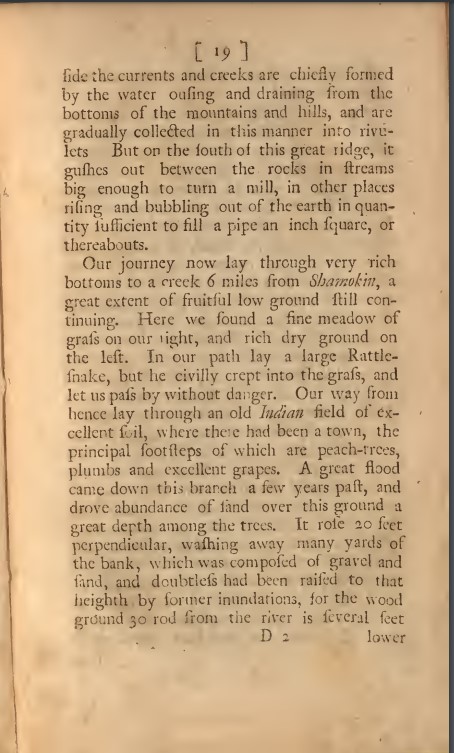
Then came the other sources. My European traveler was much more interested in urban development; so after reading through that narrative and getting some data, I decided it wasn’t really worth the effort of the data entry. It was extremely difficult to follow where exactly Bartram was at most points, and even when he gave a name of a town, I had to double check to see if 1. it still existed and 2. if it still had the same name. The Indian town of Shamokin is now Sunbury, PA and there is a Shamokin, PA, but not anywhere close to the original. That was the easy one to find out. Other place names seem to have disappeared from the record as well as the map. But he gives great information as to flora and fauna. Is it “worth” the time to figure out exactly where he was? Probably, if I want to be as thorough as possible in showing change in flora and fauna over time. I encountered many of the same problems with the Jesuit Relations. The Jesuits also used French renditions of Iroquois place names that are then translated into English. Fun.

All of the authors of these narratives were interested in recording the flora and fauna of the lands through which they traveled to learn how best they could be exploited as resources. With this, one must always consider if there is exaggeration of quality or quantity in their descriptions? Jacobs is traveling to and serving in Hudson Bay Co. communities. Are some of these observations somehow to serve the HBC? The Jesuits were also looking for resources along with souls. How does this affect the way they write? These questions remain whether we are collecting information for a data to be input into a mapping program or a more traditional qualitative study.

I still believe this project could be useful in answering the questions of how the environment of Upstate NY and the Great Lakes changed over time, but I see this as being a much larger undertaking than originally thought. I also have to consider more the data I am collecting and the tools I am using. I think there are questions I haven’t considered to ask given the abilities of the tools. This course and this project has helped me to see a bit further as to what lies ahead.

final reflections on my introduction to digital public humanities

This introductory class on DPH has been eye-opening, at times a bit overwhelming, and overall enjoyable. In many ways, I wasn’t sure what to expect from the class and my goals were rather low-bar: know more than I did when I began and hopefully enough to be able to do some self-guided learning. I believe I did that. I like to tell my own students that if you leave class with more questions than you came in with, that is a good thing.

I believe my definition of DPH remains fairly the same as it was in the beginning. I still very much believe it has to be a collaborative project. Even though I did the work on my own, I never would have been able to get where I am without Dr. Mullen’s help, and I got a lot out of my classmates comments. Moreover, the introduction of work in various parts of DH shows how scholars from different backgrounds have come together to create the technology, methods, research, interpretations, etc. No one person could achieve this work on their own. It’s also interesting to see that while most traditional works of history scholarship are created by individual scholars, many DH projects have a several individuals contributing.

I do have a better understanding now of the “big umbrella” idea of DPH and some of the problems with that. Are digital archive collections governed by the same rules and methods as networking projects? Is the former really an extension of archive management and something separate from a project like Orbis or podcasts? With so many digital approaches to archiving, researching, and disseminating knowledge it seems that maybe the umbrella has gotten too large to do its job. it’s an interesting question to pay attention to as I continue with this program.

While I learned quite a bit about digitizing collections, metadata, and copyright as ways of presenting mostly primary source material for the use of researchers, I was most interested about the technologies used to research and disseminate findings. I love maps. I have always loved maps. I torment my students daily with maps. I really enjoyed the mapping tools we worked with. I used kepler for my final project, but I am still a novice at best. I have to sit and think about how best to use this tool. As was reinforced throughout the class readings, the technology is a tool and does not replace having to create a sound methodology based on good questions. I have to consider methodology and the questions such tools could help with. Network analysis was totally new to me, and I look forward to exploring that method more.

I leave this class now mostly with the question of how do I limit myself with the options available. I have a big interest in mapping, network analysis, and podcasting. My institution is also in the process of hiring a new librarian who would be a part-time, and our only, archivist with an advisory board to help. I will be on that board. How much of digital practice do I bring in there? I found the class readings and videos particularly helpful in asking questions of how to decide what one may want to or should digitize in an archive, even though this is not my main interest. I also need to ask how much of this could/should I try to bring into my own classes. I’ve seen some really interesting collaborative work with students that has given me some ideas with my own classes. There are many possibilities under that big umbrella, and I need to find the part where I belong.

Early american travel narratives and environmental history

I am slow, but I get there eventually. After leaving my first career, I started my PhD work in 1997, which is the same year Jose Antonio Brandao published his book, “Your fyre shall burn no more” Iroquois Policy Toward New France and its Native Allies to 1701. Brandao challenged the interpretation of the Beaver Wars, where Haudenosaunee supposedly engaged in warfare with other nations to dominate the beaver fur trade with New France. In doing so, he utilized the Jesuit Relations by counting the numbers of pelts recorded as captured in Haudenosaunee raids on other nations. Most of the book was made up of appendices showing his evidence. “No!” I exclaimed! “How can one overturn major historical interpretation by using sources in such a way?” I’m slow, but I get there. Yes, you can use sources in wild and crazy ways.

I have recently moved into the world of environmental history, with a particular interest in upstate NY, where I am located, and the Great Lakes. This project is the very slow start of thinking of how to use travel narratives to map environmental change over time.

I looked at four sources in particular, but really succeeded in mapping just one so far. These sources were found in the Early Encounters in North America database, published by Alexander Street. The idea was to first look at the word cloud produced by Voyant to get an understanding of what the author’s were focusing on. Then using Kepler I would chart the location of non-human animals, plants, and soil conditions as observed in the narratives. I am going slow, but I am getting there.

Journals of the Reverend Peter Jacobs 1852

As you can see from the above Voyant word cloud, Jacobs’s focus was not on the natural word so much as the spiritual. He’s there to convert Indians, but the fact that he is also travelling to Hudson Bay Co forts, economics is on his mind. His view of the natural world, like most Europeans had to do with how the natural world could be converted to commodities, which does go hand in hand with converting Indians to Christianity. He’s looking for God and gold, but we can also map out the presence of fish, plants, trees, copper, etc from his work. See below for that.

Flint’s letters from America 1818

Flint was less concerned about souls, and most of his observations were more about the cities he encountered than the natural world. This was more of an experience of spending much time reading with less to show in the end.

Observations on the inhabitants, climate, soil, rivers, productions, animals, and other matters worthy of notice, made by Mr. John Bartram, in his travels from Pensilvania to Onondago, Oswego, and the lake Ontario, in Canada, to which is annex’d, a curious account of the cataracts at Niagara, by Mr. Peter Kalm, a Swedish gentleman who travelled there. 1751

John Bartram was a naturalist who travelled extensively through the American colonies. As you can see from the word cloud, while he makes observation on many aspects of the region of what are now PA and NY, it’s water that steals the show. Rivers, lakes, creeks, are at the center of his travels and records.

Jesuit Relations and Allied Documents, vol 43, Chapter IV: Journey of the Fathers of our Society, and some Frenchmen, to the Country of the Upper Iroquois called Onnontoeronnons. 1653

Like Jacobs, the Jesuits were looking for souls, oh, and some gold too. I work at a Jesuit college. The Jesuits continue to celebrate their 17th century work among the Onondaga Nation of the Haudenosaunee. The Onondagas do not share that point of view. They see the Jesuits arrival more as a search for commodities and the first steps to eradication of the Onondaga people. So that is a different issue, but one that is always on my mind. I am not dealing with that question here, but I throw it out if anyone has ideas on how to approach it. Remember, I’m slow, but I get there.

Okay, so what about the mapping! The word clouds show us a different story from the one I am trying to uncover. I must say, mapping Jacobs’s narrative is where I had the most success (except for apparently drowning the city of Toronto in the middle of Lake Ontario).

The map above shows the locations of his travels and the animals he recorded seeing. This is particularly useful in tracking the timing and extent of impact of invasive species on native species in the Great Lakes, particularly the four above Niagara Falls. The Falls served as a barrier for invasive species, but the Erie Canal offered one entry point for invasive species above the falls, then the creation of the Welland Canal, which could take some ships up and around the falls offered another. Both were opened at the time Jacobs took this journey. At this point, native species of trout, whitefish, and sturgeon remain numerous.

After going through Flint’s narrative, I decided, at least for the moment, it was not worth mapping as his observations dealt mostly with increased manufacturing in cities through which he traveled. This could make a possibly interesting project, but it doesn’t fit the needs of this experiment. I slowly move on.

JR vol 43 Chapter IV

You cannot study Indigenous history in Iroquoia without dealing with the Jesuit Relations. There are problems, many problems. So a new problem exposed itself to me as I wanted to create maps. That problem is the use of place names. There was no standard spelling in the 17th century, plus, I am dealing with a translation, plus names have changed. Many times, there was no name used, you just had to figure it out “the river that feeds Gannentaa” is the Oswego River. Gannentaa is now called Onondaga Lake. That was the easy part. I believe these sources are going to be key in creating a larger environmental understanding of this region, but it is going to take time. Luckily, I’m used to going slow.

I can say the same thing for Bartram’s journal. He travels by land and water, and it can be quite difficult to figure out exactly where he is.

First, the modern city of Shamokin, PA is not where the original Indian village of Shamokin was located. The Shamokin to which Bartram refers, is actually Sunbury, PA. Mostly he is traveling up the east branch of the Susquehannah River, but where he is along the river is difficult to say. I thought I had him tracked, but then he was suddenly in Onondaga, and if he followed the path I thought, well, he would have had to fly to get to Onondaga so quickly. This will take some time and thought about how best to use such sources and the questions I want to ask of them. A slow process, but I will get there.

virtual reality and history

The pandemic hit, travel stopped, and suddenly I was getting messages from many people and institutions about online tours of museums and historical sites. You can experience history without leaving your home! It’s the next best thing to being there! Well, I guess virtual reality experiences are the next best thing to being there, depending on what the “there” is one may be visiting or what the “there” you are visiting is trying to do.

Starting with the virtual tours of historic sites and history museums, I’m a fan, as a place to start. When trying to orient yourself to a particular event in a particular space, say a the WWI Battle of the Somme, a virtual experience is quite helpful. You can get an understanding of landscape and movement across the land much better than a static map with red and blue arrows. Virtual reality experiences that let you control the view is even better at trying to immerse an individual in the setting as he or she must be engaged. That engagement gets the user to think a bit more about what he or she is looking at and where he or she may “go” next. Hopefully the next stop would be to the actual site, if possible. People go to actual historic sites to experience something a bit more authentic, to put oneself in the position of being there. Virtual reality can do that to an extent, but I would think giving the user control would be key.

Tours that are more passive–click the arrow, read the caption–are a bit less engaging for me. I liken it to a less than inspired lecture with a few PowerPoint slides. And while such tours give us the opportunity to see art and artifacts we may otherwise not have access too, I find it hard to gain the same appreciation. But even with a more “realistic” virtual reality experience, I see these opportunities to be more of a starting point to prepare for the actually going to the sites and museums where one is much more in control of where one directs his or her attention and the questions one may ask.

Games offer a way to be engaged, and I am a big fan of games, but I will say a life at sea is not for me, and I would not really recommend the game from the USS Constitution museum to anyone except maybe my six-year old nephew. First it reminded me that as a youth I was never any good at arcade games. Second, I didn’t really learn anything. I could see my six-year old nephew enjoying a chance to play a computer game and make poop jokes. My middle-aged self found that less appealing. I may try an experiment with my nephew to see what his level of curiosity and engagement with such an experiment. His father also likes to play more sophisticated video games, such as Assassin’s Creed, and I know a lot of work goes into such games to give a realistic feel of the place and time. Of course, once the game commences the fantasy part becomes the main focus. So he plays the game, and I observe the setting.

For me, the VR experience is great for creating a setting. The weaknesses come in creating the greater context for better historical understanding. Balancing the visual and control experience with the actual contextual experience is the challenge. But, of course, that is the challenge for most public history projects. How do you keep your audience engaged and immersed, while also communicating complex historical ideas? It is a challenge, but a rewarding experience when they do come together.

History and podcasts

I have struggled a bit with the history and podcasts. On one hand I believe they can be a great way of delivering history to a public audience (no normal person wants to read my articles.) On the other hand, it took me a while to find some that I thought were good history and presented in a compelling way.

The big advantage of presenting through history is reaching that audience. As Liz Covart said in her interview, the general public is very interested in learning history, but traditional scholarly publication is not an ideal delivery method to that audience. The success of heritage tourism has also shown there is a big audience for history, but not everyone has the ability to travel, and the pandemic has shut much of that down as well. But with a smart phone, which it seems just about everyone has, anyone can listen to a podcast.

But how do you find a good podcast? One that provides accurate information and tells a story of historical significance, but one that is not merely a scholarly paper being read out loud. Unlike with scholarly publishing there are no “gatekeepers” to make sure podcasts meet standards of historical research, accuracy, and ethics. Determining that is left to the listener. Luckily, with the success of many podcasts created by scholars, it gives more credence to Covart’s observation about the desire of non-academics to learn good history.

The challenge for historians then, is to make that podcast compelling for the non-academic as well as the academic audience. As I was listening to, and enjoying, the Throughline Podcast on bananas, I couldn’t help but think of my students who always seem to be more drawn to books written by journalists than by historians. “It reads more like a story and not history.” Sigh. Throughline, an NPR podcast, is created and hosted by journalists, and they tell a good story. AND they rely on historians to do some of the heavy lifting. As an NPR production, they also have the staff and resources to add some killer production value in music and travel and interviews and getting the rights to Harry Belafonte’s Banana Boat song for part. And they connected it to something we all know and experience but never really think about: why do we eat these strange fruits in the first place? So, yeah, I found that quite compelling.

I will also say, while not having the bells, whistles, and resources that comes with NPR, I found the Consolation Prize podcast quite compelling. I had no idea about Richard Greener before this podcast. The story was quite compelling and the scholars gave clear explanations as to the significance. The editing was done in a way to make it sound a bit more conversational as well. And, while not Harry Belafonte, there was music, which helped to “set a mood.”

Now the challenge would be, how do you reach that audience? NPR podcasts need much less advertising. How do you get the word out about Consolation Prize and reach an audience who would find the story compelling, but probably wouldn’t merely come across the podcast? You can build it, but will they come?

At my institution a few of us have been discussing the possibility of a locally oriented podcast; the working title is “Syracuse in the Crossroads” and would explore the historical events in Syracuse and the surrounding area. I have a colleague who tells our students that in the 1840s and 1850s there was no more exciting place to live in the US than Syracuse. One of the events that happened then was the Jerry Rescue, which involves the arrest and then rescue of a fugitive slave in Syracuse after the passage of the fugitive slave act. It has drama: violence, jail breaks, carriage chases. It has a great cast, besides Jerry himself, there is abolitionist Gerrit Smith, Frederick Douglass, Daniel Webster, just to name a few. It reveals the significance of the growing abolition movement and the role of northern states rights (most people don’t think about that.) And it has historians who have worked to put this into that context that could lend credence to the story. I would love to do this story as a podcast, but with my articles, would the only audience be me and my father?

Crowd sourced knowledge and fakes

Looking at my title for this post, it makes me think that many academics might believe it to be redundant. Isn’t all crowd sourced information found online a fake? It cannot be trusted. Who knows who is actually making these posts? Do they know what they’re talking about?

I’ve maintained my own reservations of crowd sourced knowledge, like Wikipedia, but the more I learn the more I see that inaccuracies or misrepresentations can be dealt with. The safety next is in the crowd. Sure there are people out there who deliberately place false information into sources, such as the John Sigenthaler example where false information was placed in his entry as a type of joke. It stayed a while but was eventually found. More on intentional fakes later. More likely are inaccuracies and less malicious misrepresentations. How are these to be handled in crowd source information?

It seems the best way is the crowd itself. From my own experience, many more academically inclined individuals believe that those participating in crowd sourcing are people with no knowledge. It is true they may have no academic credentials, but some are quite knowledgeable about certain events, ideas, people. Sometimes a bit too knowledgeable. The numerous editors and other Wikipedia users are quite thorough and quick in catching errors or misrepresentations. This is especially true in purely factual information, and it is in the purely factual where Wikipedia has its strengths, which was made clear by Roy Rosenzweig in his article “Can History Be Open Sourced?” These numerous editors and contributors can be considered the peer reviewers of the crowd sourced encyclopedias.

It is in historical interpretation where things get messier in crowd sourcing, and where it may be more difficult to the “peer reviewers” to be helpful. Interpretation must go beyond the purely factual, and here is where academic historians may find the crowd sourcing to be truly problematic. Calling out misrepresentations can be difficult and lead to, as David Auerbach said, “a rancorous, sexist, elitist, stupidly bureaucratic mess.” However, anyone who has gone through an blind, academic, peer review process could probably say the same thing. Yeah, I’m talking about you “reviewer #2!”

No system is perfect and we must also consider the intent of the sources, especially intended audience. People are curious and often have very specific questions they’re looking to have answered. How did the asteroid belt form? Who is John Sigenthaler? What the heck are Digital Humanities anyway? Crowd sourced knowledge is quite beneficial in answering these questions AND in leading people to more sources and information to go further in their queries. Research of a brand new topic, especially for students, usually starts with reference sources, and crowd sourced knowledge like Wikipedia provides a good source that is available to anyone who has internet access (who has internet access is another issue and one highlighted during the pandemic.)

Then there are the truly malicious attempts to pass off a source as authentic that is really not. Although advances in technology seem to make this more prevalent, fakes are nothing new. From the Hitler diaries to the recently revealed Vinland map fake at Yale’s Beinecke library (although this came as no real shock to many scholars) fakes have been around, and scholars, especially librarians and archivists, remain alert to their presence. Of course now it’s not a single material object that can be faked, but a video, sound recording, photograph, etc. and these technological fabrications can be spread far and wide via social media in particular.

It seems simple to merely dismiss all use of technology in such a manner as unethical and unacceptable, but, like with so much else, once you dig a little deeper, it gets a bit more complicated. Is using software that can recreate Anthony Bourdain’s voice in order for it to “read” some of Anthony Bourdain’s words the same as using that same technology to have Bourdain seemingly say things like “McDonald’s is the only decent restaurant in the world!” They do not seem equivalent in intent.

Photoshop allows users to doctor images like never before. But is this the first time photography has misled? Famed Civil War photographer Matthew Brady rearranged scenes of fallen soldiers before shooting the picture. This was purposeful intent and would be quite problematic today. At that time the technology was still new especially in “photojournalism” and the rules yet to be written. So do we just need a new set of rules to deal with this technology? Who gets to write them and how do they keep up with the rapidly changing technology? Can I answer these questions? No. Maybe we should crowdsource it? You can check out Deepfake on Wikipedia and see what it has to say.